
The Problem Was Never Discipline. It Was Friction.
You didn't quit tracking because you lacked willpower. You quit because it took too long. Here's why logging speed is the single most important factor in nutrition tracking success, and how reducing it to 5 seconds changes everything.
You downloaded a calorie tracking app on a Monday. By Wednesday, you logged every meal. By the next Monday, you stopped opening it. By the end of the month, you deleted it.
Conventional wisdom says you lacked discipline. That you weren't serious enough. That you needed to "want it more."
That explanation is comforting. And completely wrong.
The problem was never you. The problem was friction.
The Hidden Tax on Every Meal
Traditional calorie tracking is, at its core, a data entry job. Every single meal follows the same exhausting ritual: open the app, search for the food, scroll through dozens of near-identical database entries, select the "correct" one, guess the portion size in grams you have never weighed, and repeat for every item on your plate.
Most logging sessions take 3 to 5 minutes. That sounds small, until you multiply it.
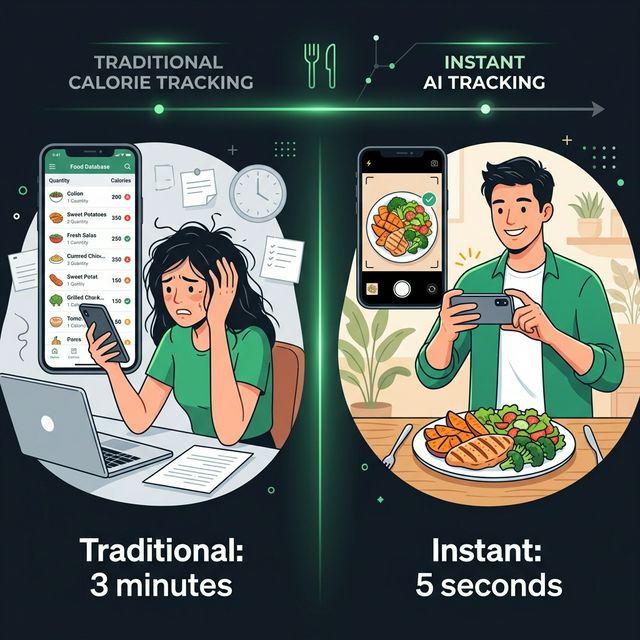
3 meals × 3 minutes × 30 days = 270 minutes per month. That is 4.5 hours of pure data entry. No habit on Earth survives that friction-to-reward ratio.
Why Habits Die from Tiny Barriers
Decades of behavioral science point to the same conclusion: habits rarely fail because of dramatic obstacles. They fail because of tiny, repeated friction.
The gym is too far, so you stop going. Meal prep takes too long, so you stop cooking. Logging takes too many taps, so you stop tracking.
James Clear, the author of Atomic Habits, calls this the "Two-Minute Rule": if a habit takes more than two minutes to start, the odds of doing it consistently drop dramatically. Traditional calorie tracking violates this rule at every single meal.
The implication is profound. Consistency is not a character trait. It is an engineering problem. And the solution is not more motivation. It is less friction.
Consistency is not about willpower. It is about removing resistance. If the tool is fast enough, the habit becomes automatic.
The 5-Second Rule of Nutrition Tracking
Here is the thesis: if logging takes 3 minutes, it feels like work. If logging takes 5 seconds, it feels like a reflex.
That single difference changes the entire psychology of tracking. There is no mental negotiation. No "I will log it later." No guilt spiral when you forget. Just: do it, done, move on.
But achieving a 5-second log is not about having a camera. It is about designing for real life.
People do not eat in controlled environments. They eat while commuting, working, socializing, traveling, multitasking. A frictionless tracker must adapt to context:
- 📸 Photo Scan:Point your camera at the plate. AI identifies every item, estimates portions, and returns full macros. Done in the time it takes to snap a selfie.
- 🗣️ Voice Entry:Say "two eggs, toast with butter, and black coffee." The AI parses natural language and presents the breakdown for a quick review. Confirm with one tap and you are done.
- ⌨️ Quick Text:Type a short description. No searching through databases. No scrolling through 200 results for "chicken breast." Just describe what you ate in plain English.
- 📊 Barcode Scanner:Point at the package. Two seconds. Done. The fastest possible path for anything with a label.
- 🏷️ Nutrition Label Scan:Take a photo of the nutrition facts panel. OCR reads every line. No manual entry. No typos.
- ⭐ Frequent Re-Log:Eat the same lunch every Tuesday? Tap it in your frequent meals list. Zero API calls. The fastest log possible: under one second.
The goal is not to have one fast method. It is to have a fast method for every situation in your life. Because consistency does not care about your best days. It cares about your worst ones.
Speed Is Only Half the Battle
Here is what most "fast tracking" tools get wrong: they optimize for the initial log but ignore what happens after. And what happens after is where trust is built or destroyed.
Modern AI vision models are already remarkably capable, and improving rapidly. They can identify a complex curry, estimate portion sizes, and break down macros from a single photo in seconds. But food is genuinely hard to classify visually, even for humans. Can you tell the difference between lamb and beef in a stew just by looking? Can you distinguish almond butter from peanut butter on toast? These are edge cases that challenge human eyes just as much as artificial ones.
That is exactly why a great tracker pairs powerful AI with fast, intuitive correction tools. Not because the AI is unreliable, but because the combination of speed plus refinement produces the most accurate log possible.
The Edit Loop: Refine in Seconds
Traditional apps force you into a binary: accept the log or delete it. There is no middle ground. A modern tracker gives you fine-grained control to refine any detail, as fast as the initial log itself.
- Inline Editing:Tap any food item to adjust the amount, unit, or serving size. Change "150g" to "200g" and watch the macros recalculate instantly. No re-scanning. No re-searching.
- AI Reanalysis:Describe what you want adjusted in plain language. "That was grilled, not fried" or "I only ate half." The AI reanalyzes the entire meal with your refinement baked in. One sentence does what would take 5 minutes of manual editing.
- Positive Feedback:When the AI nails it, tell it. This is not just satisfying. It helps the system learn your specific eating patterns and get even more accurate over time.
- Servings Multiplier:Ate two servings instead of one? Slide a single control. Every macro scales proportionally. No calculator needed.
The best log is not the one that is perfect on the first try. It is the one that reaches perfection in under 10 seconds.
Why Busy People Especially Need This
Let us be direct about who this is for. Busy professionals do not lack motivation. They lack spare attention.
By 4 PM, you have already made hundreds of decisions. What to wear. How to phrase an email. Which meeting to prioritize. Your willpower battery is running low. This is exactly when most people reach for a snack and exactly when most people skip logging.
For this audience, nutrition tracking has to feel like sending a text message. Not like filing a tax return.
- Waking up?Voice entry while making coffee: "Oatmeal with banana and almond butter." Review, tap, done.
- At work?Photo of your lunch in the break room. Three seconds.
- Grabbing a protein bar?Barcode scan. Two seconds.
- Same dinner as last night?Tap the meal from your recent list. One second.
- AI got the portion wrong?"That was a small bowl, not large." Fixed.
The Consistency Flywheel
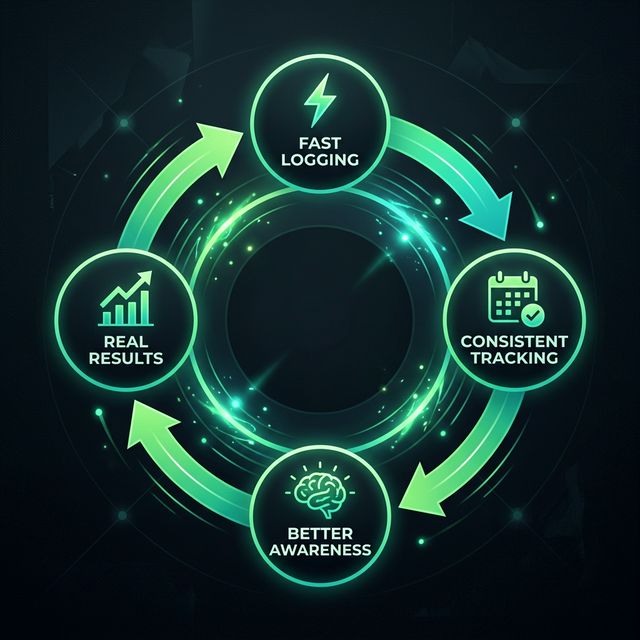
When logging becomes frictionless, something remarkable happens. A flywheel effect kicks in.
Fast logging leads to more consistent tracking. Consistent tracking creates better nutritional awareness. Better awareness drives better food decisions. Better decisions produce real, visible results. And visible results make you want to keep logging.
This is not a linear progression. It is a self-reinforcing loop. And it only starts spinning when the initial friction is low enough to never break the chain.
Add a gamification layer on top of this (streaks that build, badges that unlock, levels that rise) and the flywheel gains even more momentum. Tracking stops feeling like a task and starts feeling like progress.
The psychology shifts from obligation to identity. You stop being someone who is "trying to diet" and start being someone who tracks. That shift is permanent.
You don't build consistency with discipline. You build it with speed. Remove the friction, and the habit sustains itself.
The Bottom Line
Every failed diet, every abandoned tracker, every guilt spiral about "not being disciplined enough" traces back to the same root cause: the tool asked too much of you, too often.
The fix is not trying harder. It is demanding less from yourself at the moment of action.
If logging takes 3 minutes, you will quit. If it takes 5 seconds, you will win. Not because you became more disciplined. But because the barrier finally became low enough for the person you already are.
The problem was never discipline. It was friction. Remove the friction, and consistency takes care of itself.
Frequently asked
Why do most people quit calorie tracking apps?
The primary reason is friction, not lack of motivation. Traditional tracking requires 3 to 5 minutes per meal of manual searching, scrolling, and data entry. That adds up to over 4 hours per month. No habit survives that level of daily friction, regardless of how motivated you are.
How fast should meal logging be to maintain consistency?
Research on habit formation suggests that any action taking more than two minutes to initiate has significantly lower adherence rates. Ideally, meal logging should take under 10 seconds. AI-powered photo logging, voice entry, and barcode scanning can achieve this, making tracking feel like a reflex rather than a chore.
What is the best way to track calories without spending too much time?
Use a tool with multiple fast input modes. Photo scanning for prepared meals, voice entry when your hands are busy, barcode scanning for packaged foods, and one-tap re-logging for meals you eat frequently. Having the right mode for every situation eliminates the mental negotiation that causes people to skip logging.
How do you refine an AI-generated meal log?
Modern AI vision models are remarkably accurate and improving every day, but food can be visually ambiguous even for human eyes (think lamb versus beef in a stew). The best tracking tools pair AI speed with intuitive refinement: tap to adjust portions, describe a correction in plain language for instant reanalysis, or use a servings multiplier. The result is a log that reaches full accuracy in under 10 seconds.
Does gamification actually help with nutrition tracking?
Yes. Streaks, XP systems, and achievement badges create a psychological feedback loop that transforms tracking from an obligation into an identity. Research on habit formation shows that once a behavior becomes part of your self-image, adherence increases dramatically. The key is that gamification only works when the underlying action (logging) is fast enough to sustain daily.
Is AI calorie tracking accurate enough to be useful?
Yes, and it is improving rapidly. Modern vision models can identify complex dishes, estimate portions, and break down full macros from a single photo. For the occasional edge case where food is visually ambiguous, fast refinement tools let you fine-tune the result in seconds. The combination of AI speed and human refinement produces the most accurate and sustainable tracking experience available.