
Your Weight Loss Timeline is a Lie (And That's Why You Keep Failing)
Every fitness app shows you a clean, straight line from your current weight to your goal. But your body doesn't work like a spreadsheet. Here's why metabolic adaptation derails linear plans, and what actually works instead.
Every fitness app does this. You enter your weight. You pick a goal. And suddenly, you're shown a clean, perfect line from where you are to where you want to be.
It's neat. It's motivating. It's completely wrong.
The Straight Line Fantasy
That straight line assumes your body behaves like a spreadsheet. Same calorie burn every day. Same hunger levels. Same energy, mood, sleep, and stress. Same rate of fat loss, forever.
But real life doesn't work like that. Some weeks you're consistent. Some weeks you're traveling. Some days you eat perfectly. Some days you don't. And your body responds to all of it. This is exactly why weight loss is not linear.
A 2016 study in the journal Obesity tracked contestants from "The Biggest Loser" and found that six years after the show, their metabolisms had slowed by an average of 499 calories per day compared to what was predicted for their size. The straight line never accounts for this.
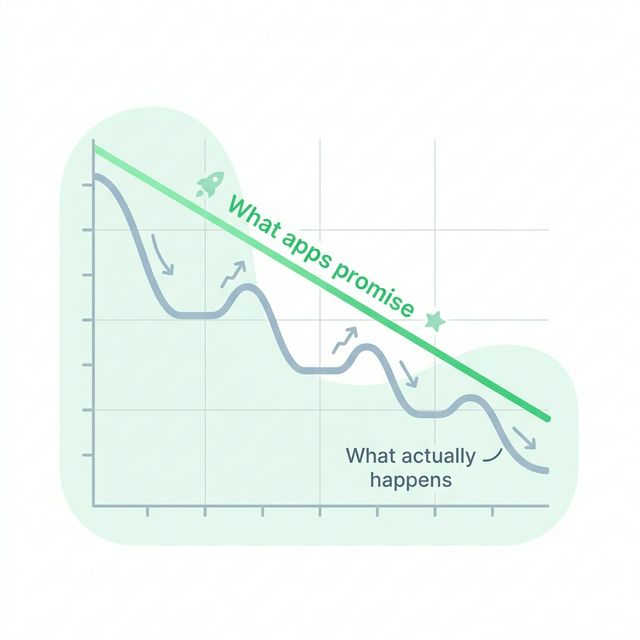
95% of published weight-loss predictions assume a linear model that ignores metabolic adaptation entirely.
Your Body Isn't Linear. It's Adaptive.
Here's the part most apps don't tell you about why fat loss slows down: your body actively fights change.
Lose weight too fast and your metabolism slows. Eat less and your hunger hormones spike. Push too hard and your energy drops while cravings rise. This is a well-documented phenomenon called metabolic adaptation (also known as adaptive thermogenesis).
An NIH-funded study published in the American Journal of Clinical Nutrition found that for every kilogram of weight lost, resting metabolic rate decreases by approximately 20 to 30 calories per day beyond what the loss of tissue alone would predict. Your body literally becomes more efficient at conserving energy the harder you push.
This isn't failure. This is biology doing its job. So when your progress slows down, it's not because you "lost discipline." It's because your body is trying to protect you.

For every 1 kg lost, your body burns 20-30 fewer calories per day than predicted. This is not a bug. It is a feature of human survival.
The Real Reason 30-Day Transformations Fail
Fast results look exciting. But they come with hidden costs: extreme restriction, unsustainable routines, mental burnout, and rebound weight gain.
A landmark UCLA meta-analysis reviewing 31 long-term diet studies found that up to two-thirds of dieters regained more weight than they lost within four to five years. The faster and more extreme the initial loss, the more dramatic the rebound.
This is not because people lack willpower. It is because they were chasing a timeline their body could never sustain. Rapid weight loss triggers a cascade of hormonal responses: elevated ghrelin (the hunger hormone), suppressed leptin (the satiety hormone), and a metabolic rate that stays depressed long after the diet ends.
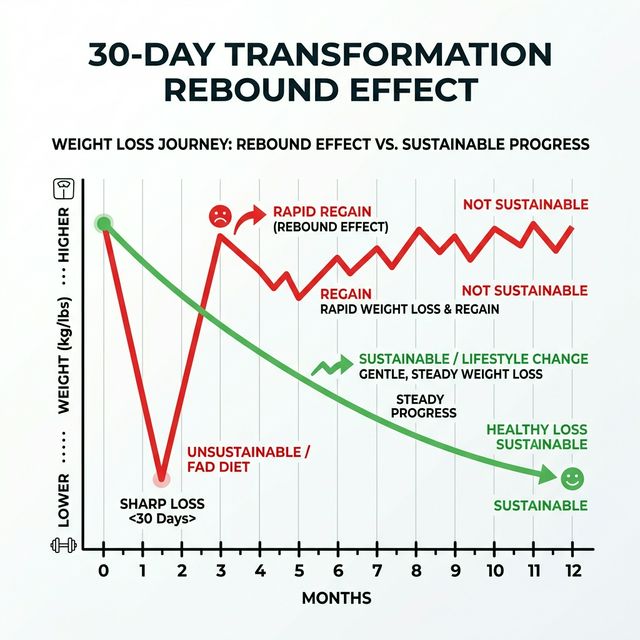
Up to two-thirds of dieters regain more weight than they initially lost within 5 years (UCLA meta-analysis, 2007).
The Three Paces of Progress
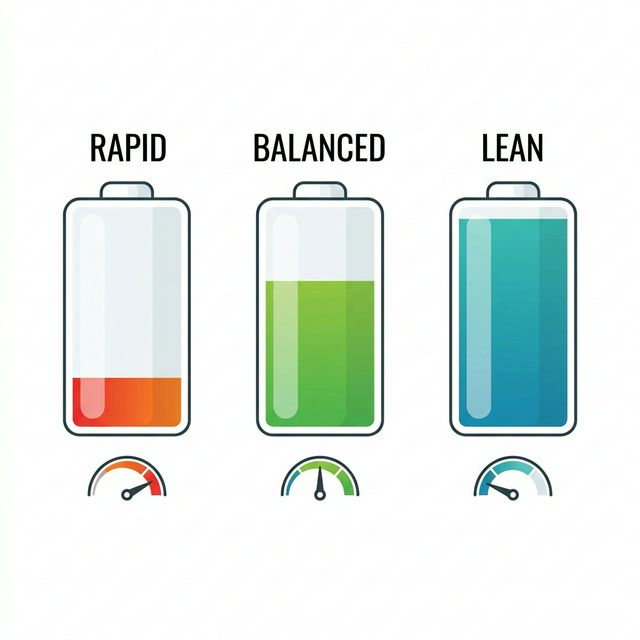
Instead of one "perfect" speed, there are actually three ways to approach progress. None of them are right or wrong. What matters is choosing the pace you can actually maintain.
- Rapid:Fast results, high effort, hard to sustain. Useful when you're highly motivated, but carries the highest risk of burnout and metabolic pushback. Recommended only in short bursts.
- Balanced:Steady progress, moderate effort, sustainable. This is where most people succeed long-term. A deficit of roughly 500 calories per day, or about 0.5 kg (1 lb) per week, is widely considered the sweet spot in clinical nutrition research.
- Lean (Slow):Slower results, low stress, highly sustainable. Perfect for busy phases of life, maintenance transitions, or when you just need to keep the habit alive without pressure.
The Biggest Mistake: Treating Slow Progress as Failure
You start strong. Things slow down. And suddenly it feels like you're failing. So what do you do? You push harder. Cut more calories. Try to "get back on track."
And that's where everything breaks. Because instead of adapting your pace, you fight your own reality.
Research from the National Weight Control Registry, the largest ongoing study of long-term weight loss maintainers, consistently finds that the people who keep weight off are not the ones who lost it fastest. They are the ones who developed a sustainable pace and stuck with it through the inevitable plateaus.
The National Weight Control Registry found that successful long-term maintainers lose weight slowly and adapt their approach over time, not sprint toward a deadline.
What Actually Works
Long-term success isn't about staying fast. It's about adjusting your pace without quitting.
- Busy week?Slow down, but don't stop. Even a tiny deficit keeps you moving forward.
- Low energy?Ease off, but stay consistent. Maintenance is not failure.
- Hit a plateau?Adapt. Increase protein, adjust your target, or take a planned diet break. Don't punish yourself with more restriction.
- Bad day?Log something, anything. A five-second photo keeps the habit alive.
The people who succeed aren't the most disciplined. They're the ones who don't break when things aren't perfect.
A Better Way to Think About Progress
Stop asking: "How fast can I lose this weight?" Start asking: "What is a realistic weight loss timeline that I can sustain for the next 3 months?"
Because that's the real game. Not intensity. Not perfection. Sustainability.
When you stop chasing a perfect timeline, you don't panic when progress slows. You don't quit after a bad week. You don't feel like you're constantly "behind." You just keep going. And ironically, that's what actually gets you there.
The Bottom Line
Your weight loss journey isn't a straight line. It's messy. It's adaptive. It's human. And once you accept that, you stop fighting the process and finally start working with it.
If there's one shift to make, it's this: progress isn't about speed. It's about staying in the game long enough to win.
You didn't fail the diet. The timeline failed you.
Frequently asked
Why does weight loss slow down over time?
Your body undergoes metabolic adaptation. As you lose weight, your resting metabolic rate decreases beyond what the loss of tissue alone would predict. Studies show a reduction of 20 to 30 calories per day per kilogram lost. This means your body becomes more efficient at conserving energy, causing weight loss to naturally decelerate.
Is rapid weight loss dangerous?
Rapid weight loss is not inherently dangerous in the short term under medical supervision, but it significantly increases the risk of muscle loss, nutrient deficiencies, gallstones, and metabolic slowdown. The bigger risk is the rebound: research shows that faster initial loss is strongly correlated with greater regain within five years.
What is the best rate of weight loss?
Most clinical guidelines recommend 0.5 to 1 kg (1 to 2 lbs) per week as a sustainable target. This moderate deficit preserves muscle mass, minimizes metabolic adaptation, and is associated with the best long-term maintenance outcomes according to the National Weight Control Registry.
How do I break through a weight loss plateau?
Plateaus are a normal part of weight loss caused by metabolic adaptation. Effective strategies include reassessing your calorie target for your new weight, increasing protein intake to preserve lean mass, incorporating resistance training, or taking a planned diet break where you eat at maintenance for one to two weeks to reset hunger hormones.
Why do most diets fail long-term?
A UCLA meta-analysis of 31 long-term studies found that up to two-thirds of dieters regain more weight than they initially lost. Diets fail because they are designed as temporary interventions rather than sustainable behavior changes. The restriction-rebound cycle is driven by biological responses (increased hunger hormones, decreased metabolism) that persist long after the diet ends.