
Why 80% of People Quit Calorie Tracking Apps (And It's Not Laziness)
The real reasons millions abandon calorie tracking within weeks, and what the data tells us about the future of nutrition apps.
You download a calorie tracking app on a Monday. By Wednesday, you're dutifully logging your breakfast, lunch, and dinner. By the following Monday, the app sits unopened. By month's end, you've deleted it entirely.
Sound familiar? You're not alone. Studies consistently show that the vast majority of people who start tracking their food intake abandon the habit within two weeks. The conventional wisdom says they simply lack discipline. That's wrong.
The problem isn't motivation. The problem is the calorie tracking apps themselves.
Why Do People Quit Calorie Tracking Apps?
Research published in the Journal of Medical Internet Research found that fewer than 3% of users of popular diet-tracking apps maintain consistent daily logging after six months. A separate study from the Duke Global Health Institute found that median engagement with nutrition tracking apps drops by 90% within 30 days of installation.
These aren't lazy people. These are people who cared enough to search for a food tracking app, download it, create an account, and start logging. They had every intention of sticking with it. Something drove them away.
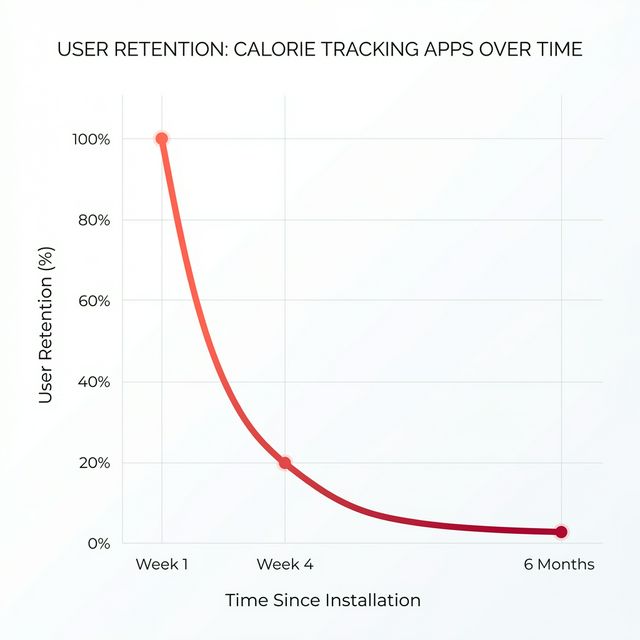
Fewer than 3% of calorie tracker users maintain daily logging after 6 months.
Manual Food Logging Is Too Time-Consuming
The average person eats 3 to 5 times per day. Each logging session with a mainstream food tracking app involves: opening the app, searching for the food item, scrolling through dozens of near-identical database entries, selecting the correct one, choosing the right portion size (in units that rarely match what you actually ate), and repeating this for every single item on your plate.
Conservative estimates put each manual food logging session at 3 to 5 minutes. That's 10 to 25 minutes per day spent doing what amounts to data entry. Across a week, you're spending over an hour on a task that provides zero immediate gratification.
No habit survives that friction-to-reward ratio. This is why calorie tracking fails for most people.
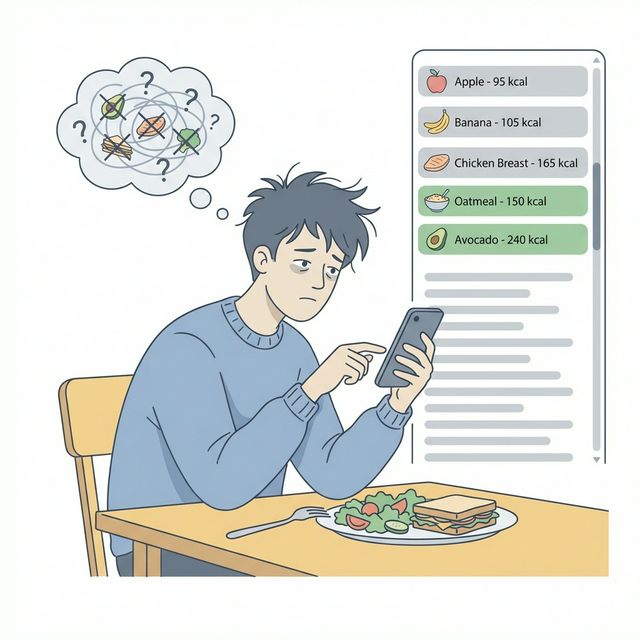
Food Databases Are Inaccurate and Overwhelming
Mainstream calorie tracking apps rely on massive, crowdsourced food databases. MyFitnessPal, for example, boasts over 14 million food entries. That sounds impressive until you realize the majority are user-submitted, unverified, and often wildly inaccurate.
Search for "chicken breast" and you might get 200+ results with calorie counts ranging from 120 to 400 for what appears to be the same item. Users are forced to become amateur nutritionists, cross-referencing entries and guessing which database entry most closely matches what's actually on their plate.
For anyone looking for a MyFitnessPal alternative, database accuracy is usually the first pain point. This uncertainty breeds anxiety, not confidence. And anxious users quit.
Why Tracking Homemade Meals Is So Difficult
Database-driven nutrition tracking works reasonably well for packaged foods with barcodes and chain restaurant meals with published nutrition facts. It falls apart completely for homemade cooking, which is, ironically, the healthiest way to eat.
Made a stir-fry with chicken, broccoli, bell peppers, garlic, soy sauce, and sesame oil? You now need to log six separate ingredients, estimate the quantity of each, and hope the app's database has entries that match what you used. Most people simply don't bother. They either skip the meal or enter something generic like "stir fry" and accept the inaccuracy.
The best calorie tracking app should make home cooking easy to log, not punish you for it.
Restaurant Tracking Is Where Nutrition Apps Break Down
Perhaps the cruelest irony of calorie tracking: the moments when you most need nutritional guidance (dining at restaurants, eating at social gatherings, ordering from a new menu) are precisely when the apps are least helpful.
You're at a restaurant with friends. The menu has 40 items, none of which are in the app's database. Do you pull out your phone and spend 10 minutes trying to estimate the macros of "Pan-Seared Chilean Sea Bass with Citrus Beurre Blanc"? Of course not. You either skip tracking for the meal (creating a data gap) or guess wildly (creating inaccurate data).
Either way, the food tracking app has failed you at the exact moment you needed it most.

Calorie Tracking Apps Punish Instead of Helping
Most nutrition tracking apps are fundamentally retrospective. They tell you what you already ate and how it compared to your goals. Go over your calorie limit? Red numbers. Missed your protein target? Another red indicator.
This creates a dynamic where the app feels like a judge rather than an ally. There's no forward-looking guidance, no proactive help. Just a ledger of sins.
Behavioral psychology is clear on this: punishment-oriented feedback loops are far less effective at building habits than reward-oriented ones. Yet most calorie tracking apps are built entirely around the punitive model.
What We Are Doing About It
People don't quit tracking because they aren't motivated enough. They quit because most apps are built for data entry, not for real life. We believe technology should respect your time and your mental energy.
Every one of these friction points is a design problem that can be solved. We are rethinking the entire experience to focus on what actually works for people who want results without the stress.
This is just the start. We are mapping out the future of nutrition apps, and we want you with us.
Frequently asked
Why do most people quit calorie tracking?
The biggest reasons are time-consuming manual logging, inaccurate food databases, difficulty tracking homemade meals, stress when eating at restaurants, and punitive app design that focuses on what you did wrong instead of helping you make better choices.
Are calorie tracking apps accurate?
Many popular calorie tracking apps rely on crowdsourced databases with user-submitted entries that are often unverified. This means calorie counts for the same food item can vary wildly, making it hard to trust the numbers.
Is there an easier way to track macros?
Newer approaches to nutrition tracking are moving away from manual database searches. AI-powered food recognition and smarter logging methods are making it possible to track meals in seconds rather than minutes.
What percentage of people stick with calorie tracking?
Research shows fewer than 3% of users maintain consistent daily logging after six months, and engagement with nutrition apps drops by 90% within 30 days of installation.
Why is calorie tracking so hard?
Calorie tracking typically requires 10 to 25 minutes of daily data entry, involves navigating unreliable food databases, and becomes nearly impossible for homemade meals and restaurant dining. The process is designed around data entry rather than user experience.