
Why Macrite
Nutrition apps, minus the usual problems.
Numbers you can't trust. Advice made for someone else. Logging that wears you down. These are the things people complain about most. Here's how Macrite handles each one.
Problem 1 · Numbers you can't trust
A calorie count is only useful if you can believe it.
The usual answer
Photo trackers are good at naming your food and much weaker at the math. A tablespoon of cooking oil goes unseen, a portion is misjudged from a flat photo, and the same plate can come back with different numbers.
How Macrite handles it
Macrite doesn't let the AI do the math unchecked. Calories are calculated from the protein, carbs and fat it finds, every value is checked against what's physically possible, and portion estimates correct for how cameras misread depth. The AI is asked for its most consistent answer, not a creative one. Cooked with oil? One tap adds it.
- 1
Your photo
Resized on your phone first
- 2
Foods & portions
Using visible size cues
- 3
Protein · carbs · fat
Estimated per food
- 4
Physics check
Impossible values corrected
- 5
Calories calculated
From the macros, not guessed
- 6
You review
Nothing logs without you
Problem 2 · Advice made for someone else
Your body isn't a trend.
The usual answer
A lot of nutrition advice comes from feeds: a video, a creator, a what-I-eat-in-a-day. It's made for an audience, not for you, and in one study of 250 popular posts, only about a third were completely accurate.
How Macrite handles it
Your targets are calculated for your body from published methods: the Mifflin-St Jeor equation for energy, ISSN guidance for protein, and American Heart Association limits for sugar and saturated fat. Every suggestion after that is based on your own day, not someone else's.
of popular TikTok nutrition posts were completely accurate.
Problem 3 · "So what do I eat now?"
Knowing your numbers doesn't tell you what to eat.
The usual answer
Most trackers record what you already ate and stop there. You end up with 800 calories and 60 grams of protein left, and no idea what dinner should be.
How Macrite handles it
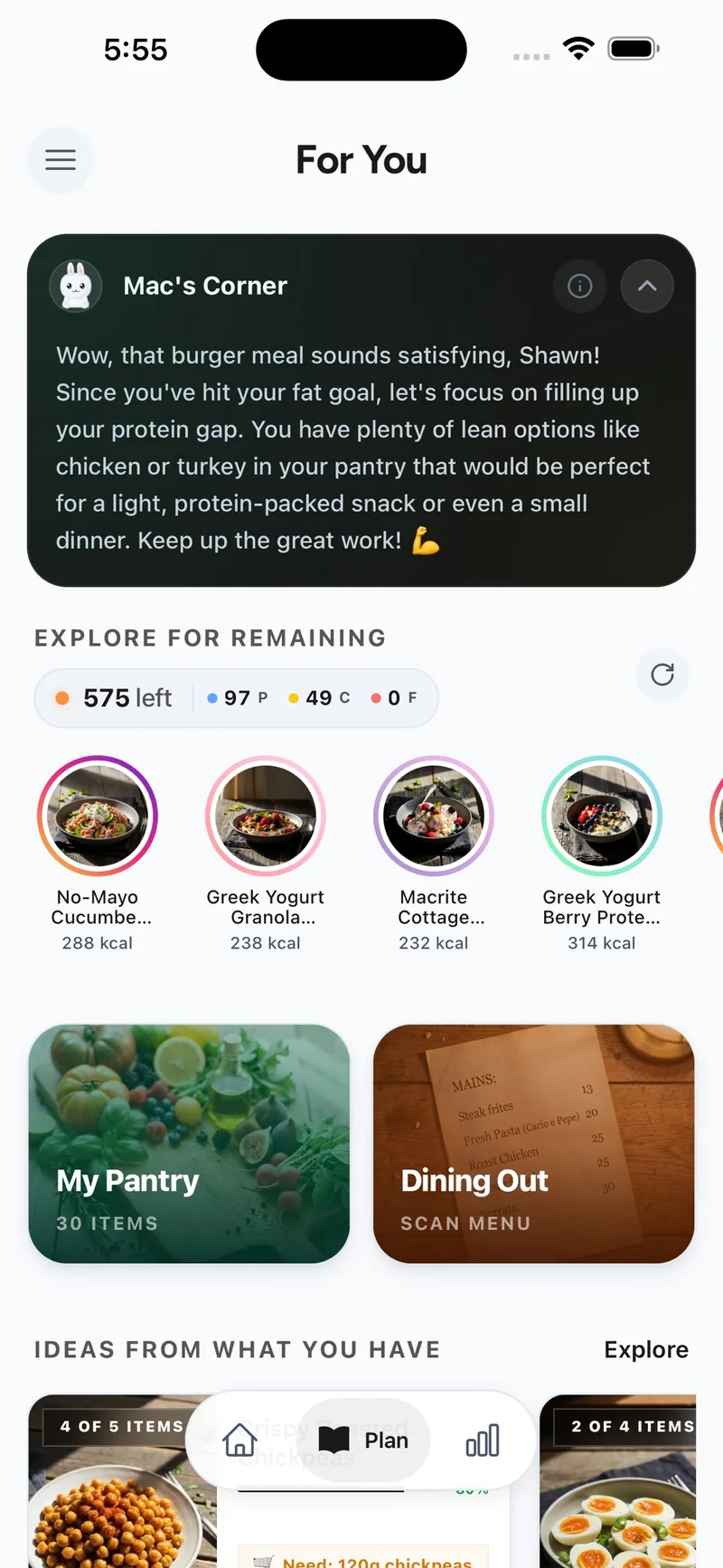
Mac's Corner looks at what's left in your day and suggests a next meal that fits. And when you'd rather cook with what you have, scan your fridge or pantry: Macrite turns it into recipe ideas from its own curated library, ranked by how well each fits.
of 364 restaurant meals exceeded the recommended calories for a single meal.
Problem 4 · Eating out
Eating out shouldn't mean giving up on your goals.
The usual answer
Restaurant portions are big, menus rarely show nutrition, and guessing is hard. So people either skip the meal out, or order and hope for the best.
How Macrite handles it
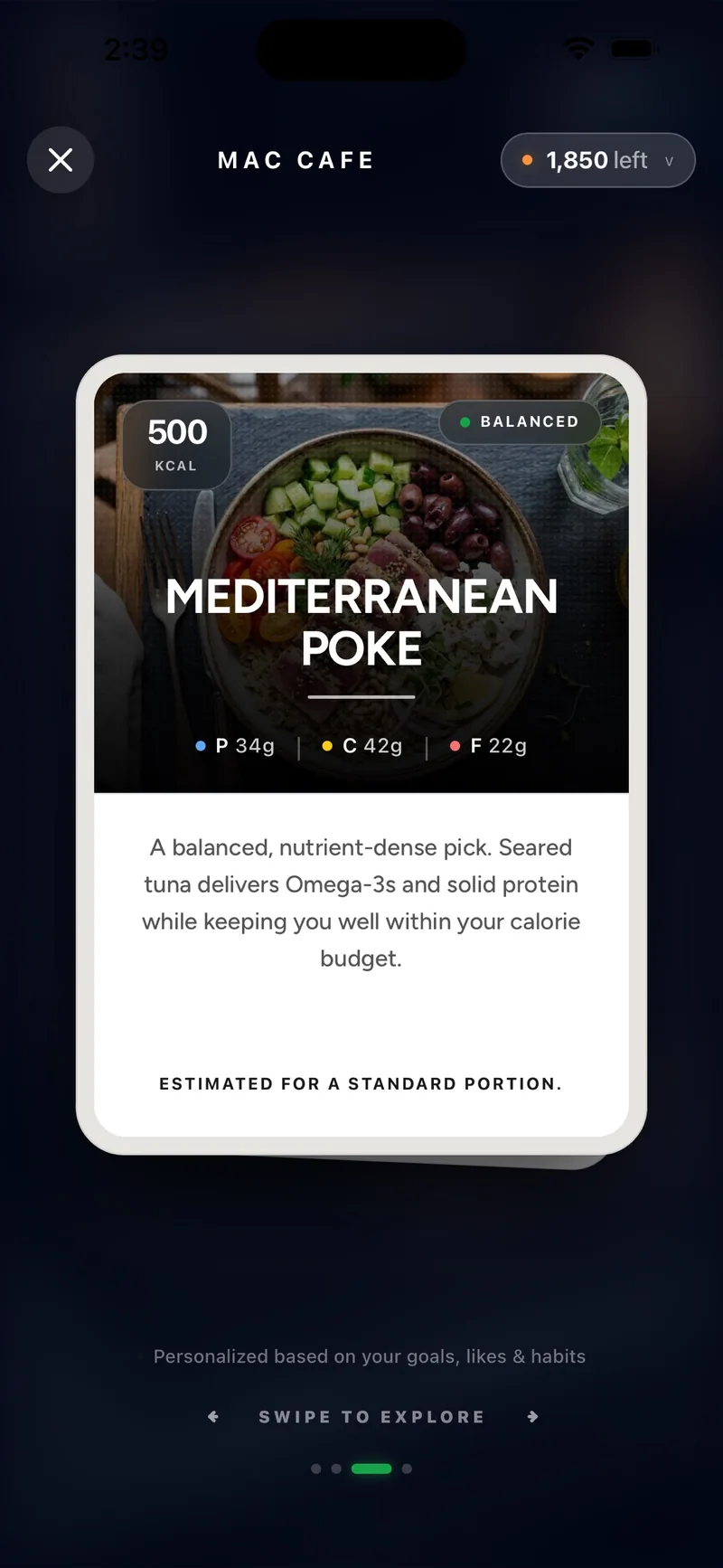
Scan the menu. Macrite picks the dishes that best fit what's left of your day, down to the size and the add-ons, and it only recommends dishes it actually read on the menu. No guessing, and no skipping dinner with friends.
Problem 5 · Logging that wears you down
Tracking fails when logging feels like homework.
The usual answer
Search a database, scroll through dozens of near-identical entries, pick a serving size, repeat for every ingredient. It's no surprise so many people stop.
How Macrite handles it
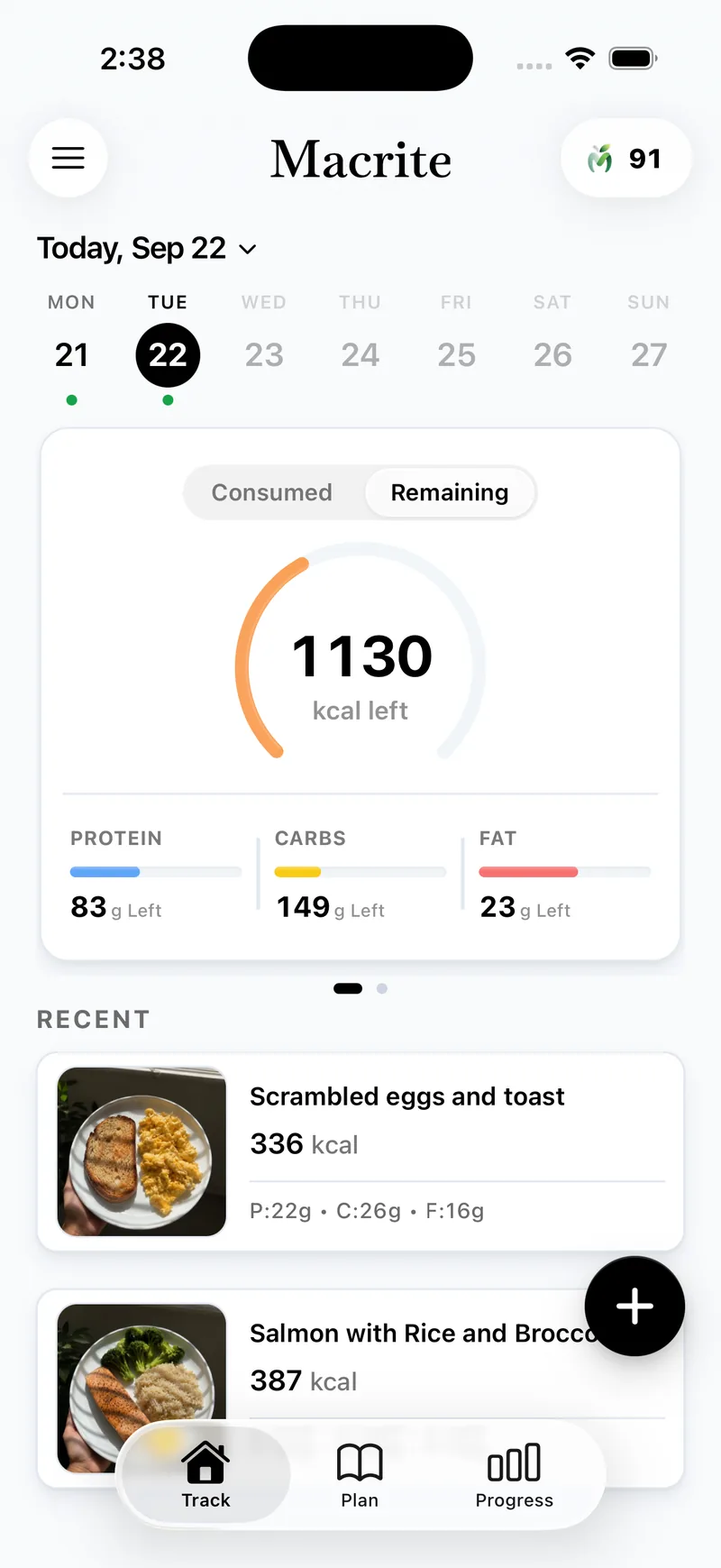
Log however is easiest right now, and if something's off, just say so in plain words, like "add a side of rice".
- Photo
- Voice
- Text
- Barcode
- Nutrition label
- Past meals
Problem 6 · Your data, their business
Privacy by design.
Free apps pay for themselves somehow, usually with ads and constant upselling. Macrite has no ads, and your personal details are never sold or shared with advertisers.
Questions
What is Macrite?
Macrite is an AI nutrition companion. You log meals by photo, voice, text, barcode or nutrition label, and it tracks your calories and macros. It also helps you decide what to eat next: at home, at restaurants, and from what's already in your kitchen.
How accurate are Macrite's photo estimates?
Any photo estimate is an estimate, and Macrite is built to keep it honest. Calories are calculated from the protein, carbs and fat it finds rather than guessed, every value is checked against what's physically possible, and you review each meal before it's logged. For packaged food, the barcode and label scanners give exact numbers.
Can Macrite help me eat out without going over my goals?
Yes. Scan the menu and Macrite picks the dishes that best fit your remaining calories and macros for the day, including sizes and add-ons, and it only recommends dishes it actually read on the menu.
Is my personal information private?
Yes. Your personal details are never sold or shared with advertisers, and your name, email and account are never shared with AI providers. There are no ads.
Which languages does Macrite support?
Macrite is available in English, German and Spanish.
Switching from another app? See Macrite vs MyFitnessPal, or browse the full FAQ.
Go beyond tracking.
Snap your next meal and see what a nutrition app that checks its own math feels like.